
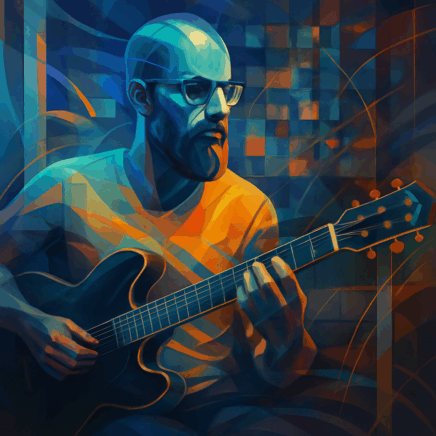
Nous avons publié il y a quelques mois une chronique de l’album Changeling, le premier album éponyme de Tom Geldschläger (aka Fountainhead) sous l’identité de groupe Changeling, paru en avril 2025 chez Season of Mist : un disque où la guitare fretless imprime une couleur unique, porté par un line-up de haut vol — Morean (chant, Alkaloid/Dark Fortress), Arran McSporran (basse fretless, Virvum/Vipassi), Mike Heller (batterie, Fear Factory) — et une multitude d’invités. Entre Death technique et metal progressif moderne, arrangements audacieux (cordes, chœurs, piano, microtonalité) et grande diversité vocale, l’album s’impose comme une proposition ambitieuse et personnelle. Pour aller plus loin, voici un entretien avec l’artiste derrière le projet, autour de sa trajectoire, de l’album et de sa vision d’une musique à la fois ambitieuse et personnelle.

Interview – Changeling (français)
The original English version can be found below.
Je vous ai découvert via votre participation à Akróasis d’Obscura (2016). Sans ressasser le passé, qu’est-ce qui a mené à cette collaboration ? Que faisiez-vous musicalement juste avant ? Était-ce déjà dans une veine death technique ?
Avant mon implication avec Obscura, j’étais déjà musicien professionnel depuis plus de dix ans — j’ai joué dans des groupes allant du balkan-folk au metal progressif, jusqu’au death metal technique, mais aussi produit et mixé pour d’autres artistes, co-écrit avec des gens et enseigné la guitare. J’avais sorti mon premier album solo “Fear Is The Enemy” en 2012, ce qui a amené mon vieux pote Christian Münzner à me demander de prendre sa place dans Obscura. Au moment où “Akroasis” est sorti, j’avais aussi terminé mon deuxième album solo “Reverse Engineering” ainsi que deux albums avec le “Pitts/Minnemann Project”, un groupe instrumental prog-fusion avec le batteur légendaire Marco Minnemann.
Depuis la période Akróasis, qu’avez-vous fait ? Travaillez-vous à plein temps dans la musique ? Des participations, du studio, des tournées à mettre en avant ?
Je n’ai jamais arrêté — même pendant la pandémie, j’écrivais “Changeling” et je subvenais à mes besoins en tant que musicien pro. Depuis 2016, j’ai participé à un nombre à trois chiffres d’albums comme guitariste, producteur, ingé mix/mastering, orchestrateur et compositeur ; j’ai tourné dans le monde avec Defeated Sanity, Belphegor & Nader Sadek, écrit des livres, ajouté l’oud à mon arsenal, sorti une vidéo pédagogique, donné des masterclasses et coaché des centaines de personnes sur la créativité, l’expression de soi et la santé mentale, monté mon trio instrumental et effectué ma première tournée solo en tête d’affiche en Inde. Une sortie marquante que je recommande à tous est le double album “IV” d’Amogh Symphony (2019).
En dehors de Changeling, travaillez-vous actuellement sur d’autres projets ou collaborations ?
C’est mon métier et ma passion, donc il y a toujours quelque chose qui mijote. Dans le mois qui vient, par exemple, je dois enregistrer, produire et mixer le premier album d’Amuse To Death (un projet mêlant swing-jazz et metal progressif), masteriser la moitié du prochain album de Moran Magal, produire/mixer et masteriser le prochain EP de Pyre (un groupe hardcore berlinois) et j’ai été invité à enregistrer deux solos de guitare par d’autres artistes. Il y aura aussi plusieurs guitar playthroughs de Changeling qui sortiront avec un tout nouveau remix stéréo de l’album.
Quelles ont été vos premières influences à la guitare ? En tant que metalleux allemand, Necrophagist a-t-il compté tôt pour vous, ou plus tard ?
C’est drôle que vous demandiez Necrophagist, car j’ai un jour passé une audition pour eux. J’ai un grand respect pour ce que Muhammed a fait, mais cette audition était honnêtement pour moi la toute première fois où je jouais du death technique ; je ne peux donc pas dire que j’ai été influencé par eux à mes débuts — mais ils m’ont clairement inspiré à travailler plus dur et à devenir meilleur. Quant à mes premières influences guitare : Joe Satriani, Steve Vai, Criss Oliva, David Gilmour, Jeff Beck, Shawn Lane, Terje Rypdal, The Edge, David Torn, Eric Johnson, Bumblefoot, Steve Morse…
Changeling est votre premier album sous ce nom de groupe. Pourquoi une identité de groupe plutôt qu’une sortie sous votre nom ou “Fountainhead” ? Voyez-vous désormais Changeling comme un groupe au long cours ou surtout un projet studio ?
La sortie sous un nouveau nom était le souhait du label. Ils pensaient pouvoir mieux le promouvoir ainsi. Est-ce que ça a marché ? Je ne sais pas. Ce que je sais, c’est que j’aimerais continuer dans ce style, et que le contrat de Changeling couvre plus qu’un seul album.
Vous avez réuni un noyau impressionnant et une longue liste d’invités. Comment avez-vous rassemblé tout le monde ? Était-ce des amis/collaborateurs, ou des invitations ciblées ?
Changeling a-t-il déjà joué en live ? Visez-vous une tournée ou des dates ciblées ? Si oui, Morean assurerait-il le chant sur scène ?
Les ambitions ne manquent pas, donc oui — je veux jouer autant de concerts/tournées/festivals que possible. Mais pour l’instant, aucune offre de concert. Pourquoi ? Je ne sais pas. Si quelqu’un qui lit ceci veut booker Changeling, contactez-moi ! Ceci dit, j’ai déjà joué pas mal de matière de Changeling en live, sur ma tournée en tête d’affiche en Inde en 2023 ainsi qu’avec mon trio Fountainhead. Mais le line-up de l’album n’a pas encore joué en concert. Allez, changeons ça — il ne manque que l’effort des bookers !
Vous avez produit/ingénieré le disque. Finalisé à la maison ou en studio ? Comment les parties ont-elles été enregistrées : ensemble, individuellement, à distance ?
Un peu tout. J’ai un studio à Berlin où j’ai enregistré toutes les guitares, l’oud, les chœurs, des percussions et beaucoup d’instruments orchestraux. Pour d’autres éléments, je suis allé dans différents studios pour le piano à queue, les voix lead, les claviers/percussions à lames, l’ensemble de tubes “wagnériens”, etc. J’ai enregistré un vrai orgue d’église dans une vraie église. Mike et Arran ont enregistré leurs parties dans leurs studios (US et UK), en s’échangeant des fichiers avec moi jusqu’au résultat voulu. J’ai ensuite mixé la version stéréo dans mon studio, puis la version Atmos à l’Immersive Lab avec l’ingé Atmos Eric Horstmann.
Parlez-nous de l’écriture : en tant que principal compositeur, êtes-vous parti de démos détaillées ? À quel point l’album final colle-t-il à votre vision de départ, et où les autres musiciens l’ont-ils le plus remodelé ?
D’abord, j’ai tout écrit en MIDI, puis produit des démos très détaillées où chaque instrument était joué ou programmé par moi. Ensuite, petit à petit, chaque partie a été remplacée par une performance réelle. C’était aussi un processus d’affinage continu à chaque étape — même au mix, je changeais encore des choses et optimisais les structures. Concernant l’apport des autres, difficile à quantifier avec autant de pièces en mouvement. L’une de mes forces est de croire en ma vision et de la communiquer clairement pour embarquer les gens. Mais en vingt ans de disques, je suis aussi devenu meilleur pour lâcher le contrôle quand cela sert la musique. Je ne peux pas tout faire ni tout savoir ; Changeling a été un long exercice consistant à façonner chaque élément au mieux de mes compétences, puis à faire appel au meilleur musicien possible quand j’atteignais mes limites, en passant alors en rôle de producteur/éditeur pour garantir la cohérence avec les concepts et règles posés pour ce projet.
Vous mentionnez que la version Atmos est très proche de votre vision initiale — et que l’album a été pensé pour l’audio spatial. Qu’est-ce qui change à l’écoute ? Vous avez aussi organisé des sessions publiques et été présélectionné aux Grammys ?
Oui. Changeling est le premier album d’extrême metal écrit spécifiquement pour briller en Spatial Audio. Ça fonctionne en stéréo, mais si vous entendez la “forme finale” en immersif, où la narration se déploie aussi dans l’espace 3D, vous ne l’oublierez pas. Ce n’est pas que moi qui le dis : lors de deux jours d’écoute publique au showroom Genelec de Berlin en avril, les réactions allaient toutes dans ce sens. L’album s’est ensuite retrouvé sur la liste “à nominer” des Grammys pour “Best Immersive Audio Album” et “Best Metal Performance”.
La performance vocale de Morean est un point fort — growls féroces et chants clairs expressifs. Depuis quand vous connaissez-vous et comment avez-vous travaillé ensemble ?
On se connaît depuis 2017, quand on a tous deux joué avec Nader Sadek, mais on suivait nos travaux respectifs bien avant. Je suis heureux de l’appeler un ami et une source d’inspiration. Travailler ensemble était un souhait dès le départ, et il a été mon seul choix au chant lead dès que j’ai commencé à écrire pour Changeling. Pour le process : j’ai écrit/arrangé les morceaux, créé des patterns vocaux et des démos avec moi qui “chantais” des paroles inventées. Florian a pris ces guides et a écrit les paroles à partir d’eux et de nos échanges sur l’intention émotionnelle et la place dans la structure. Nous avons ensuite enregistré deux longues sessions au studio de Matthias Landes à Rotterdam (Morean au chant, moi à l’ingé/production), ajusté les patterns et les textes, et eu des tonnes d’idées sur le moment. Ce qui manquait a été complété dans son home-studio et envoyé pour intégration.
La guitare fretless est devenue votre signature. Qu’est-ce qui vous y a attiré au départ ? Comment avez-vous choisi vos instruments ? Des artistes fretless (guitare ou autres cordes) vous ont-ils inspiré ?
C’est arrivé par accident. En concert avec mon premier groupe, le vibrato de ma guitare principale (un modèle signature Steve Vai, l’entrée de gamme) a littéralement arraché la table — je l’avais un peu malmené… Je l’ai apportée au seul réparateur de ma petite ville ; l’instrument était en piteux état, pas vraiment “rentable” à sauver, mais on s’est dit que ça pouvait servir d’expérience. Je venais de découvrir Ron “Bumblefoot” Thal qui expérimentait la fretless ; sur un coup de tête, j’ai demandé qu’on la passe fretless sans savoir à quoi m’attendre. Vingt ans plus tard… À part Ron, je n’ai jamais vraiment cherché ce que faisaient les autres — et il y en avait très peu. J’ai tracé ma propre route, guidé par la musique sur laquelle je travaillais et par des instruments non-guitare : violoncelle, oud (que je joue désormais), koto, flûtes du monde et, bien sûr, la voix humaine.
Vous aimez repousser les limites. Quels passages de l’album ont été les plus difficiles à concrétiser — microtonalité, couches orchestrales, rythmes, production ?
Honnêtement, tout l’album a été une lutte. Les chapitres 3 & 4, qui font intervenir tout l’ensemble (groupe, orchestre, chœurs), ont pris le plus de temps tant ils sont complexes. Mais le plus difficile a été de décider de faire cet album. Je souffre de trouble de stress post-traumatique complexe, et ce qui s’est passé pendant/après la réalisation d’Akroasis y a contribué. Revenir à ce style en tant que compositeur/interprète était quelque chose que je ne voulais ni ne me sentais capable de faire pendant des années. En arriver à pouvoir lancer Changeling a demandé des années de thérapie et de travail intérieur.
Changeling est clairement “progressif” d’esprit. Comment comprenez-vous ce terme ? Quels artistes/repères ont façonné votre idée du “progressif” ?
Pour moi, être “progressif”, c’est défier les normes, chercher ce qui n’a pas encore été fait et combiner des éléments auxquels personne n’avait pensé. Beaucoup d’artistes m’ont impressionné, mais peu se retrouvent dans l’étiquette “prog rock/metal”, souvent devenue un autre ensemble de règles. Adolescent, j’écoutais Ulver, Squarepusher, Tim Berne, David Bowie, Björk, Mike Oldfield, Frank Zappa, Joe Hisaishi… mais aussi Death, Cynic, Morbid Angel ou Strapping Young Lad. Tous sont “progressifs” à leur manière et ont poussé leur art plus loin. C’est ce que j’ai toujours voulu faire.
Merci pour cet échange et longue vie à Changeling.
Première session d’écoute mondiale de Changeling en Dolby Atmos au showroom Genelec de Berlin, les membres du groupe et plusieurs collaborateurs étaient présents, ci-dessous Arran (basse), Tom (guitare) et Morean (chant).

Interview – Changeling (English)
I first discovered your work through your involvement in Obscura’s Akróasis (2016). Without dwelling on the past, could you share what led to that collaboration, and what you were doing musically just before? Were those projects in a similar technical-death vein?
Before my involvement with Obscura, I had already been a professional musician for over 10 years – playing with bands raging from balkan-folk music to progressive metal to yes, technical death metal, but also producing & mixing for other artists, co-writing with people and teaching guitar. I had released my first solo album “Fear Is The Enemy” back in 2012, which is what led to my old buddy Christian Münzner asking me to take his place in Obscura. By the time “Akroasis” came out, I had also already finished my second solo album “Reverse Engineering” as well as 2 albums with “Pitts/Minnemann Project”, an instrumental prog-fusion band featuring legendary drummer Marco Minnemann.
Since the Akróasis period, what have you been up to? Are you working full-time in music? Any guest spots, studio work, or touring roles you want to highlight?
Yeah, I’ve not stopped working since that time – even during the pandemic, I was writing “Changeling” and kept myself afloat and alife as a professional musician. Since “Akroasis” came out in 2016, I’ve been a part of a 3-digit-amount of albums as guitarist, producer, mixing/mastering-engineer, orchestrator & composer, toured the world with Defeated Sanity, Belphegor & Nader Sadek, written books, added the oud to my arsenal of instruments, released an instructional video, given masterclasses & coached hundrets of people on creativity, self-expression & mental health, started my own instrumental trio and had my first ever solo headline tour of india. It’s been quite the ride, haha. A highlight release from that time that I would like everybody to check out if would be Amogh Symphony’s “IV” double album, which we released in 2019.
Outside of Changeling, are there other projects or collaborations you’re currently working on?
This is my job & my passion, so there’s always something brewing behind the scenes. Within the next month, for example, I’m scheduled to record, produce & mix the upcoming debut of Amuse To Death, a project that I’m involved in that mixes swing-jazz with progressive metal, master half of Moran Magal’s next album, produce/mix & master the next EP by Pyre (a berlin-based hardcore band) and record 2 guest solos for different artist. There will also be multiple guitar playthroughs for Changeling that are coming out together with a brand-new Stereo-remix of the album.
What were your earliest guitar influences? As a German metalhead, did Necrophagist factor into your development early on, or did that come later?
That’s funny that you should ask about Necrophagist, as I once auditioned for them. I greatly respect what Muhammed did with Necro, but when I did audition for them that was honestly my first ever time playing technical death metal, so I cannot say that I have been influenced by when I was a budding young musician – but they did definitely inspire me a ton to work harder and become a better musician. But as far as my earliest guitar influences, I would say Joe Satriani, Steve Vai, Criss Oliva, Dave Gilmour, Jeff Beck, Shawn Lane, Terje Rypdal, The Edge, David Torn, Eric Johnson, Bumblefoot, Steve Morse…
Changeling is your first album under this band name. Why build a group identity rather than release it under your own name or the Fountainhead moniker? Do you now envision Changeling as a long-term band or primarily a studio project?
Releasing it under a new project name was the label’s wish. They felt like they could promote it better this way. Whether or not that worked, I don’t know. What I do know is that I would love to do more work in this style and that the Changeling record-deal goes over more than just this one album.
You assembled an impressive core lineup and a long list of guests. How did you bring everyone together? Were they already friends/collaborators, or did you reach out specifically for this project?
Has Changeling performed live yet? Do you have ambitions to tour or play selected shows? If so, would Morean handle vocals on stage?
There’s no shortage of ambition, so yes – I want to play as many shows/tours/festivals as possible. But as it stands right now, there haven’t been any show offers. Why? I don’t know. If anybody reading this wants to book Changeling, please do get in touch with me! That being said, I have played a bunch of Changeling material live already, both on my headline tour of india in 2023 as well as with my Fountainhead trio. But the line-up on the album has not performed live so far. Come on people, let’s change that – all it takes is the effort of booking agents!
You produced/engineered the record. Was it finalized at home or in a studio environment? How were the parts recorded—live together, individually, or via remote file exchange?
All of the above. I operate a studio here in Berlin where I recorded all guitars, oud, backing vocals, percussion & a lot of the orchestral instruments. For other things, I went to different studio spaces to record grand piano, lead vocals, mallets, the wagnerian tube ensemble etc. I recorded a real church organ in a real church as well. Mike and Arran recorded their parts in their own studio spaces in the US and UK, sending files back and forth with me until we reached the desired outcome. I then mixed the stereo version in my own studio by myself and, finally, the Atmos version at Immersive Lab studios in collaboration with Atmos mixing legend Eric Horstmann.
Can you walk us through the songwriting process? As the primary songwriter, did you start from detailed demos? How close is the finished album to your initial vision, and where did the other musicians reshape things most?
First, I wrote out the entire music in midi and then I produced very detailed demos where every instrument was either performed or programmed by me. From there, bit by bit each instrument was replaced by a real performance. That being said, it was also a process of continuous refinement where the music evolved through each stage. Even during mixing, I was still changing and tweaking things and optimizing the song-structures. As far as the input from the other musicians goes, that’s difficult to quantify for a project with so many moving parts. But let me put it this way: I think that one of my strengths as a musician is that I believe in my vision and I make absolutely sure that I can communicate that vision to the people I work with and try to excite them for the same goals that I’m working towards. I’ve always had that. But what I’ve become better and better at over the last 2 decades of making albums is to give up that control whenever it may benefit the material. There’s a lot of things that I do well as a musician and composer, but I can’t do (or know) it all. So Changeling was one big long exercise in shaping each little element as deliberately as I could on my own, but then also trying to bring in the best possible musician to take over when I reached the limits of my expertise. And then I’d trust them to do their thing and I’d switch more into the role of the producer & editor to make sure that the results work within the context of the concepts and rules that I put in place for this particular project. I hope this makes sense, haha!
You’ve said the Atmos version is very close to your initial vision — the album was conceived for Spatial Audio. What changes in the listening experience? You also hosted public sessions and landed on the Grammy “to-be-nominated” list?
But either way, the Atmos version of the album is indeed very close to my initial vision, as Changeling was the first ever extreme metal album to be written specifically to work best in Spatial Audio. It works well enough in stereo, but trust me – if you’ve ever heard it’s “final form” in immersive surround sound where the musical story-telling happens not only in music & lyrics, but also in 3D space as it was intended to, you’ll never forget the experience. And that’s not just me saying that (as obviously I’m a bit biased), but this was the audience reaction across the board when we hosted a 2-day public listening session for the album in the Genelec Showroom in Berlin back in April. Consequently, we found the album on the to-be-nominated-list for the Grammy Awards in both the “best Immersive audio album” and “best metal performance” categories.
Morean’s vocal performance is a big highlight — from ferocious growls to expressive cleans. How long have you known each other, and how did you collaborate on this album?
We’ve known each other since 2017, when we both played with a project called Nader Sadek, but have been aware of each other’s work for much longer. I’m very happy to be able to call him a friend, but also a continuous inspiration. Working together was something that I had wanted to do basically as long as we’ve known each other, and so he was my one and only choice for lead vocals as soon as I started writing the music for Changeling. As far as the collaboration goes, when I wrote & arranged the songs I also wrote vocal patterns & made demos with me “singing”/vocalizing the parts with made-up lyrics. Florian then took those guide-tracks and wrote the lyrics based on them as well as on our communication about what I wanted each part to do emotionally and in the context of the song structures. Once the lyrics were fully flashed out, we got together for 2 long recording sessions in Matthias Landes’ studio in Rotterdam with Morean singing and myself engineering & producing. Together, we built the final vocal patterns, changed the lyrics wherever necessary and came up with a ton of idea on the spot. Anything that we weren’t able to do in those session, he then completed in his home-studio and sent over the files for me to work into the material.
The fretless guitar has become a signature for you. What drew you to it initially, and how did you source/settle on your instruments? Were there particular artists on fretless or other fretless strings who inspired you?
It came to me somewhat by accident. I was playing local shows with my first ever band and one evening, the whammy bar in my main guitar (a Steve Vai signature model, but the cheapest available version) literally broke out of the guitar. I guess I had been abusing it a little too much…. So I took the instrument to the only person in my little hometown that did instrument-repairs. The guitar was in terrible condition and not really worth saving, but it we agreed that it still could but be used for experiments. And I had just discovered the music of Ron “Bumblefoot” Thal, who had just started to experiment with fretless guitars, so I asked the person in the repair-shop to make the guitar fretless on a total whim, not really knowing at all what to expect. And here we are, 20 years later… Apart from Ron, I’ve never been particularly inspired by or even interested in what other people were doing – and there were very few others to begin with. So I just built my own road-map for what felt right, mostly inspired by whatever music I was working on at the time and by non-guitar instruments, like the cello, oud (which I now also play), koto, flutes from around the world and of course the human voice.
You seem intent on pushing boundaries. Could you point to specific moments on the album that were especially challenging to realize — whether microtonal passages, orchestral layering, rhythmic concepts, or production choices?
Quite honestly, the entire album was one big struggle. Certainly chapters 3 & 4, which both features the full ensemble (meaning band, orchestra & choirs), took the longest time to complete as they have just so many moving parts and are so involved & complex. But I have to say that the most challenging part of the whole process was to make the decision to do this album in the first place. I suffer from complex post-traumatic stress disorder and what happened during and after the making of the Obscura “Akroasis” album contributed to this. Revisiting that particular style of metal as a composer & performer was something that I had not wanted or felt capable of doing for several years. So getting to the point where I could make the decision to move ahead with an album project like Changeling required years of therapy and inner work.
Changeling is clearly progressive in spirit. How do you relate to the term “progressive,” and which bands or records shaped your personal idea of what “progressive” can mean?
Good question! To me, to be “progressive” means to challenge existing norms, to strive to create things that have not been done before and to find combinations of elements that nobody has thought of before. In that sense, there’s so many artists and bands that have impressed and influenced me over the years, but there’s very few of them that you’d find in what people call “progressive rock” or “progressive metal”, as that’s often just another set of well-established rules that people adhere to. When I was a kid and teenager, I would listen to things like Ulver, Squarepusher, Tim Berne, David Bowie, Björk, Mike Oldfield, Frank Zappa, Joe Hisaishi…but also to Death, Cynic, Morbid Angel or Strapping Young Lad. To me, all of those were or are progressive in their own way, and pushed their respective artforms to new heights. That’s always what I wanted to do as well.
 Changeling
Soyez le premier à partager votre avis !
Laisser un commentaire